
Your Website's SEO Strategy Just Became Half-Obsolete (Here's the AEO Fix)
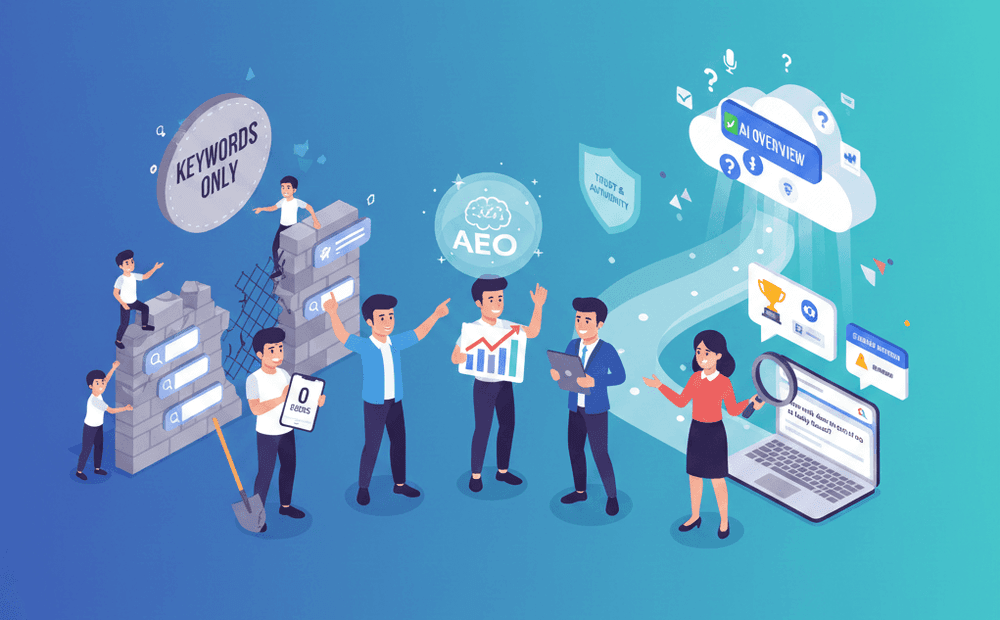
Remember when you could just stuff keywords into your content and watch the traffic roll in? Those days are dead. Google processed 8.5 billion searches daily in 2024, but here's the kicker, 60% of users never clicked on a single result. They got their answers directly from AI overviews, featured snippets, and voice assistants.
If your content isn't optimized for these "answer engines," you're basically invisible to the majority of searchers. But here's the good news: small businesses that understand Answer Engine Optimization (AEO) are actually outperforming bigger competitors who are still playing the old SEO game.
The search world split into two different games
Traditional SEO and AEO aren't competing strategies—they're completely different approaches to the same problem. Think of it this way: SEO tries to get people to visit your restaurant, while AEO tries to become the recommendation people get before they even decide where to eat.
According to Semrush's 2024 analysis, the fundamental difference comes down to success metrics. SEO measures rankings, clicks, and page views. AEO measures citations, brand mentions in AI responses, and what they call "zero-click visibility."
Here's what actually changed: Google's AI Overviews now appear on 76% of complex queries. ChatGPT became a search engine overnight. Voice searches jumped to 50% of all mobile queries. And suddenly, being the #1 result doesn't matter if the AI doesn't cite your content.
I've watched local service businesses lose 40% of their phone calls because their FAQ pages weren't structured for AI extraction. Meanwhile, their smaller competitors, who added simple question-answer formats, started dominating voice search results.
Your content needs to answer questions, not just target keywords
The biggest shift? Users stopped searching for "best plumber Chicago" and started asking "how much does it cost to fix a leaky faucet?" Natural language queries exploded, and AI engines reward content that directly answers these conversational questions.
Look at your current content strategy. If you're still building pages around keyword density and backlink opportunities, you're missing the entire conversation. AEO content needs to be scannable by AI, which means short paragraphs, clear headings, and answers that get straight to the point.
But here's where it gets interesting for small businesses: you don't need domain authority to win at AEO. A local contractor with perfectly structured FAQ content can outrank Home Depot in voice search results. Why? Because AI engines prioritize relevance and clarity over website size.
Research from ExaBytes shows that businesses implementing AEO tactics see 25-30% higher conversion rates than traditional SEO-only approaches. The reason is simple: when your content appears as the authoritative answer, users already trust you before they contact you.
Four AEO tactics you can implement this week
Start with your FAQ section. Not the generic "What are your business hours?" stuff, the questions your customers actually ask. Use tools like AnswerThePublic to find the specific language people use. Then structure each answer in 1-2 sentences under clear H2 headings.
Add FAQ schema markup. This sounds technical, but it's not. If you use WordPress, plugins like Yoast SEO generate the code automatically. This tells AI engines exactly what questions you're answering, making your content more likely to appear in featured snippets and AI overviews.
Create comparison content. AI engines love citing "X vs. Y" content because it helps users make decisions. A local fitness studio might create "CrossFit vs. Personal Training: Which Burns More Calories?" This type of content gets quoted constantly in AI responses.
Restructure your service pages with question-based subheadings. Instead of "Our Services," use "What Types of Marketing Problems Do We Solve?" AI engines parse this structure more effectively, and it matches how people actually search.
The key difference: traditional SEO content tries to keep people on your page as long as possible. AEO content gives them the answer immediately—but positions your brand as the expert who provided it.
What to do about this
Don't abandon your existing SEO efforts. Instead, audit your top 10 pages and add AEO elements to each one. Start with FAQ sections, then add schema markup using Google's Structured Data Testing Tool to validate your work.
Focus on local and hyperlocal questions first, these are where small businesses can dominate. "Best accounting software for restaurants in Denver" beats "best accounting software" every time in AI responses.
Track your progress differently. Use Google Search Console to monitor featured snippet appearances and set up tracking for AI overview citations. Test your FAQ content in ChatGPT to see if it gets cited for relevant queries.
Bottom line: The search landscape split into two games in 2024. Traditional SEO still drives traffic, but AEO drives trust and authority. Businesses that master both will dominate their markets, while competitors who ignore AEO will slowly fade into irrelevance.
Are you ready to optimize for the answers people actually want, not just the keywords they type?