
The 18-Day Earthquake That Changed Everything
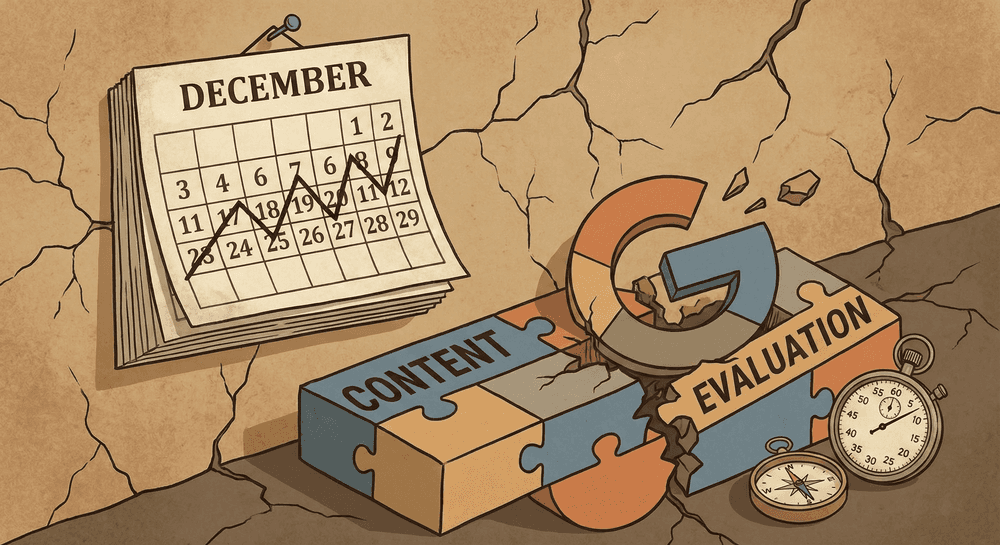
Between December 11-29, Google didn't just update its algorithm, it rebuilt the foundation of how content gets evaluated. According to comprehensive tracking, this update affected 40-60% of websites globally, with SEMrush recording a volatility spike of 8.7 out of 10, the highest of 2025.
But here's what makes this different from previous updates. Google introduced something called Temporal Confidence Scoring, essentially, your most recent user satisfaction data now carries exponentially more weight than historical performance. If users have been bouncing from your content lately, those signals just became ranking killers.
The numbers tell a brutal story. YMYL sites (finance, health, legal) got demolished first, with 67% experiencing negative impacts. E-commerce platforms weren't far behind at 52% impact rate. But the real massacre happened to affiliate sites, 71% reported significant ranking drops.
Two massive volatility spikes hit on December 13 and December 20, suggesting Google was testing and refining the new quality thresholds in real-time. Sites with poor Core Web Vitals experienced 20-30% more severe losses than competitors, proving technical performance is now a baseline requirement, not an optimization opportunity.
What "Helpful Content" Actually Means in 2026
Forget everything you thought you knew about helpful content. Google's AI can now distinguish between three distinct categories with surgical precision:
Content that wins: Demonstrates measurable expertise through specific examples, provides unique insights competitors can't replicate, and satisfies complete user intent rather than forcing additional searches.
Content that disappears: Generic industry advice written by outsiders, AI-generated summaries without human insight, and anything optimized primarily for search rankings instead of user problems.
Content that gets penalized: Misleading expertise claims, affiliate-heavy pages prioritizing commissions over advice, and thin content designed to capture traffic without delivering value.
Analysis shows the update specifically rewarded "human-edited AI content with original value" while crushing "pure AI content farms." The difference? Demonstrated experience that only someone actually doing the work could provide.
For local businesses, this means your "How to Choose a Good Contractor" article written by a freelance copywriter just became worthless. But a detailed breakdown of how you handled a specific foundation repair, complete with photos and your actual decision-making process? That's the demonstrated expertise Google now prioritizes.
Why Your Rankings Vanished (While Others Surged)
The December update exposed an uncomfortable truth: most business websites were still playing by 2020's rules in a 2026 game. While you focused on keyword density and search volume, your smarter competitors were building genuine authority signals.
Sites that maintained or improved rankings shared specific patterns:
- Technical excellence: Core Web Vitals scores that actually pass Google's thresholds (LCP under 2 seconds, CLS under 0.1)
- Trust signals: HTTPS, comprehensive privacy policies, detailed contact information, author credentials
- User satisfaction evidence: Low bounce rates, high time-on-page, and what Google calls "task completion signals"
The losers? Sites that felt generic, lacked specific business examples, or made expertise claims they couldn't back up. One recovery case study showed a 15% traffic recovery within three weeks just from fixing mobile optimization issues, no content changes required.
But technical fixes only get you baseline consideration. The real winners demonstrated what industry experts are calling "Entity-Based Authority", positioning their brand as a cited expert rather than optimizing individual pages for search volume.
The Strategic Shift That Actually Works
Don't waste time tweaking content that was fundamentally flawed from the start. The businesses recovering fastest are making three strategic shifts:
From keyword optimization to user satisfaction optimization. Instead of targeting search volume, they're solving complete user problems. Instead of 500-word blog posts, they're creating comprehensive resources that eliminate the need for additional searches.
From generic expertise claims to demonstrated authority. They're documenting their actual work process, sharing specific client results (with permission), and providing insights that only come from real experience in their industry.
From content quantity to content uniqueness. Rather than publishing 50 generic articles about their industry, they're creating 5 pieces of content that competitors literally cannot replicate because they lack the specific experience.
What To Do Starting This Week
Immediate damage control (next 30 days):
- Audit your technical performance: Use PageSpeed Insights to identify Core Web Vitals failures. Sites with CLS scores above 0.15 experienced 19% greater losses than cleaner competitors.
- Strengthen trust signals: Add detailed author bios, verify business information, include customer testimonials with real names and specific project details.
- Fix user satisfaction problems: Use Search Console to find pages with high impressions but low click-through rates, these might be ranking for queries your content doesn't actually satisfy.
Strategic repositioning (next 90 days):
- Document your unique process: Create content about how you actually solve problems, not just what problems exist in your industry.
- Build entity authority: Get mentioned and cited by industry publications, participate in relevant forums as a knowledgeable contributor, and position yourself as a go-to resource.
- Focus on complete solutions: Instead of partial answers that drive additional searches, create comprehensive resources that fully address user intent.
The next core update is expected in Q1 or Q2 2026. Don't wait to see what changes. The businesses that embrace this shift toward demonstrated expertise will own their markets while competitors keep wondering why their traffic keeps declining.
Bottom Line
Google's December 2025 update killed keyword-first SEO and replaced it with user-satisfaction-first optimization. The algorithm can now detect whether your content comes from genuine experience or generic industry knowledge. Generic loses. Demonstrated expertise wins. The question isn't whether you'll adapt to this new reality, it's whether you'll adapt before your competitors do.